
Why Cut Is the Hard Part at This Size
Every lab-grown size record above 30 carats has been an emerald cut
CVD crystals grow wide rather than deep — typically about 20% as deep as they are wide, against the roughly 60% a finished diamond needs — which is why every laboratory-grown diamond to set a size record above 30 carats has been an emerald cut, and why a genuinely well-cut large round is scarcer than an emerald of the same weight.
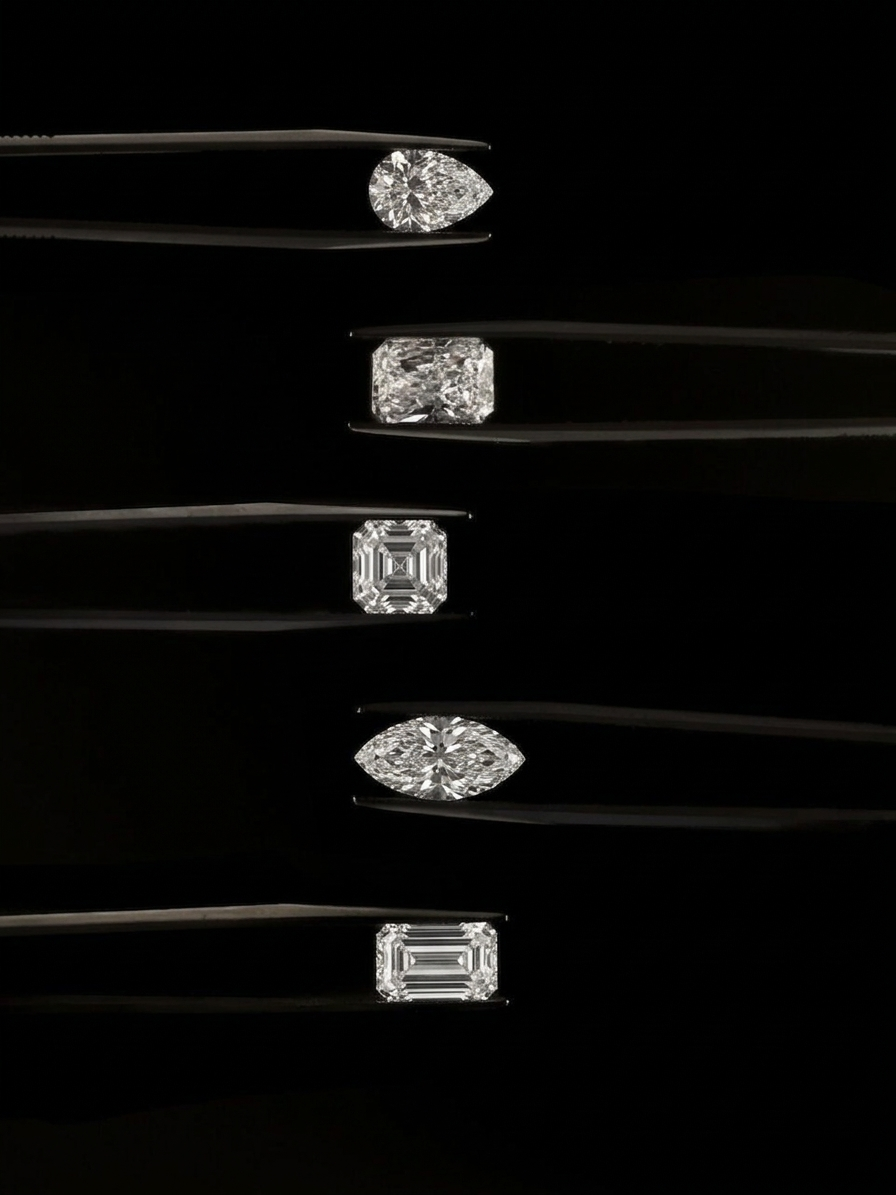
You can check the first half of that in thirty seconds. Look at the stones that have held the polished record since mid-2022: the 30.18-carat Pride of India, the 35.00-carat stone from Maitri, the 50.25-carat Shiphra, the 75.33-carat Celebration of India. Every one is an emerald or square emerald cut. The earlier, smaller records included a 16.41-carat princess; past 30 carats, there is nothing but step cuts. The full list is in our guide to how large laboratory-grown diamonds are made.
This Operia guide explains why, what that makes scarce, why the certificates can’t settle cut quality at these sizes, and what to look at instead.
Why are the biggest lab-grown diamonds all emerald cuts?
Because of the shape the crystal grows in. CVD diamond builds upward from a square seed plate, a few tens of micrometers an hour, so a CVD crystal typically comes out as a flat plate: about 20 percent as deep as it is wide, or less. A finished diamond needs far more than that. A round brilliant normally runs about 60 percent as deep as its girdle is wide.
That depth has to be grown, and growing it is the slow, interruption-prone part of the process. The record stones are not shallow: IGI measured the 50.25-carat Shiphra at 22.95 × 18.45 × 11.57 mm, about 63 percent as deep as it is wide. Its rough took about eight months to grow.
Outline decides the rest. A step cut follows the square or rectangular outline of the crystal and keeps nearly all of it. A round has to fit a circle inside that square, and a circle fills only about 79 percent of the square around it. Before depth is even considered, a round gives up a fifth of the crystal’s footprint.
What a flat, square crystal gives each shape
Round
Keeps about 79 percent of the square’s outline. The shaded corners are lost before depth is even considered.
Step cut
Follows the square and keeps all of it except the small clipped corners.
Typical CVD crystal
Grows as a flat plate, typically about 20 percent as deep as it is wide.
Finished round brilliant
Needs a total depth of about 60 percent of its diameter to handle light well.
What does that make scarce?
A genuinely well-cut large round or cushion, both brilliant-cut shapes with a deep pavilion, is scarcer than an emerald of the same weight. To finish at the same carat weight, it needs a bigger and thicker crystal, which means more growth time and more interruptions, each of which introduces new defects.
It also puts pressure on the cutter. When a crystal is only just deep enough, the choice is between a smaller round cut to good proportions and a heavier one cut outside them. The heavier stone reads better on a price list. The better-proportioned one looks better on a hand.
This is a physical scarcity, not a commercial one: nobody decided it, and marketing can’t change it. It is also a scarcity of good stones, not a statement about value. It is a reason to choose carefully, and it says nothing about what any laboratory-grown diamond will be worth later.
Why can’t a certificate settle it?
At the shapes and sizes where cut matters most, the paperwork is thinnest.
8X sets the bar high. A stone must earn Excellent in all eight of its categories: polish, external symmetry, proportions, optical brilliance, fire, scintillation, optical symmetry, and a final category that is hearts and arrows for rounds and shape aesthetics for fancy shapes. Angelo Palmieri, president of GCAL by Sarine, has noted that more than half of round brilliants receive Excellent cut grades, yet fewer than 1 percent of those qualify as 8X.
“Only diamonds that earn an ‘Excellent’ score in polish, external symmetry, proportions, optical brilliance, fire, scintillation, optical symmetry and shape aesthetics qualify for the 8X designation.”
How do you judge cut when the paper won’t tell you?
Buyers already pay for cut. On the same day, a 10.02-carat D VVS2 was listed at $7,360 ($735 per carat) and a 10.02-carat D VVS1 with an Excellent cut grade at $13,960 ($1,393 per carat), nearly double. The clarity grades differ by one step as well, so cut is not the only difference between them.
Photographs and video alone rarely settle it. One buyer, Kim N., put it plainly: “I really can’t tell anything from the videos.” Of a specific listing, the same buyer wrote: “I wouldn’t recommend the 5.04 from [a major online retailer]. It doesn’t appear to be well cut.”
Three things do more work than a video:
What to look for: light leaking through the center (windowing), dark areas that stay dark as the stone moves, and, in ovals and elongated cushions, the bow-tie shadow across the middle. In GIA research on oval, pear and marquise diamonds, observers consistently disliked prominent windowing, while opinions on bow-ties varied more.
What Operia publishes for every stone
[OPERIA TO CONFIRM: which of these are published for every stone]
Operia’s catalog is round, oval and long cushion only: the brilliant shapes this guide describes as hardest to cut well at size. Because the certificate can’t carry the full judgment, each stone’s page carries the evidence:
Frequently asked questions
Why are the biggest lab-grown diamonds emerald cuts?
CVD crystals grow as flat, square plates, typically about 20 percent as deep as they are wide. A step cut follows that square outline and keeps nearly all of it, while a round fills only about 79 percent of the square. Every laboratory-grown diamond to set a size record above 30 carats has been an emerald cut.
Can a large lab-grown diamond be cut as a round?
Yes, but it takes more crystal. A round gives up the corners of the square crystal and needs a total depth of about 60 percent, so a well-cut large round needs a bigger, thicker crystal than an emerald of the same weight.
Does GIA give a cut grade for lab-grown fancy shapes?
Not currently. GIA’s laboratory-grown assessment includes a cut grade for round brilliants only; fancy shapes receive polish and symmetry. GIA has announced cut grades for oval, pear and marquise shapes from 2027.
Is there an 8X cut grade for emerald cuts?
Not yet. GCAL’s 8X covers round, oval, princess, pear, marquise, radiant and cushion, and lists emerald as coming soon.
How can I judge cut without a cut grade?
Ask for full proportions, light-performance imaging such as ASET or Idealscope, and face-up video under consistent lighting. Look for windowing, dark areas and, in elongated shapes, a strong bow-tie.
Further guides
How Large Lab-Grown Diamonds Are Made
The polished records in order, and why size is physically hard to grow.
IGI vs. GIA for Lab-Grown Diamonds
What changed at GIA in October 2025, and what an IGI report still includes.
Carat & Size Guide
What carat weight means for a diamond's size, from 5 to 10 carats.